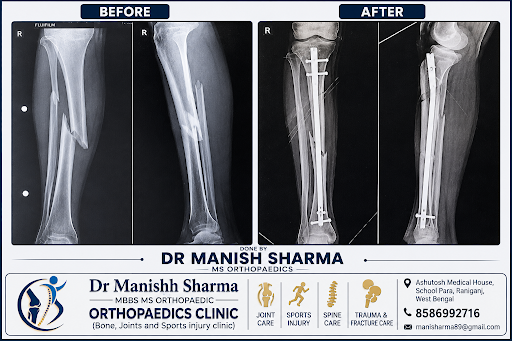
Complex Tibia & Fibula Fracture Successfully Managed
Published
A displaced tibial shaft fracture requires careful assessment, appropriate surgical planning and stable fixation. In this case, intramedullary interlocking nailing was performed to restore alignment and provide stable fixation.
🦴 Tibia Fracture –
- Tibia (shin bone) fractures are common after road traffic accidents, falls and sports injuries.
- Fractures may be simple, displaced, comminuted or segmental, depending on the injury.
- Displaced tibial shaft fractures often require accurate reduction and stable fixation.
- Intramedullary interlocking nailing is a commonly used surgical option for suitable tibial shaft fractures.
- The goals of treatment are proper alignment, stability, fracture healing and early functional recovery.
- Associated fibula fracture may occur along with tibial shaft fractures.
- Early assessment is important to evaluate soft-tissue injury, neurovascular status and compartment syndrome.
- Treatment is individualized according to fracture pattern, soft-tissue condition, patient factors and activity requirements.
- Proper postoperative rehabilitation helps restore knee and ankle movement, muscle strength and walking function.
- Timely treatment and regular follow-up are important for monitoring fracture union and functional recovery.
Done by Dr Manish Sharma, MBBS MS Orthopaedics Orthopaedics | Trauma & Fracture Care | Joint & Sports Injury Care 📍 Ashutosh Medical House, School Para, Raniganj, WB